
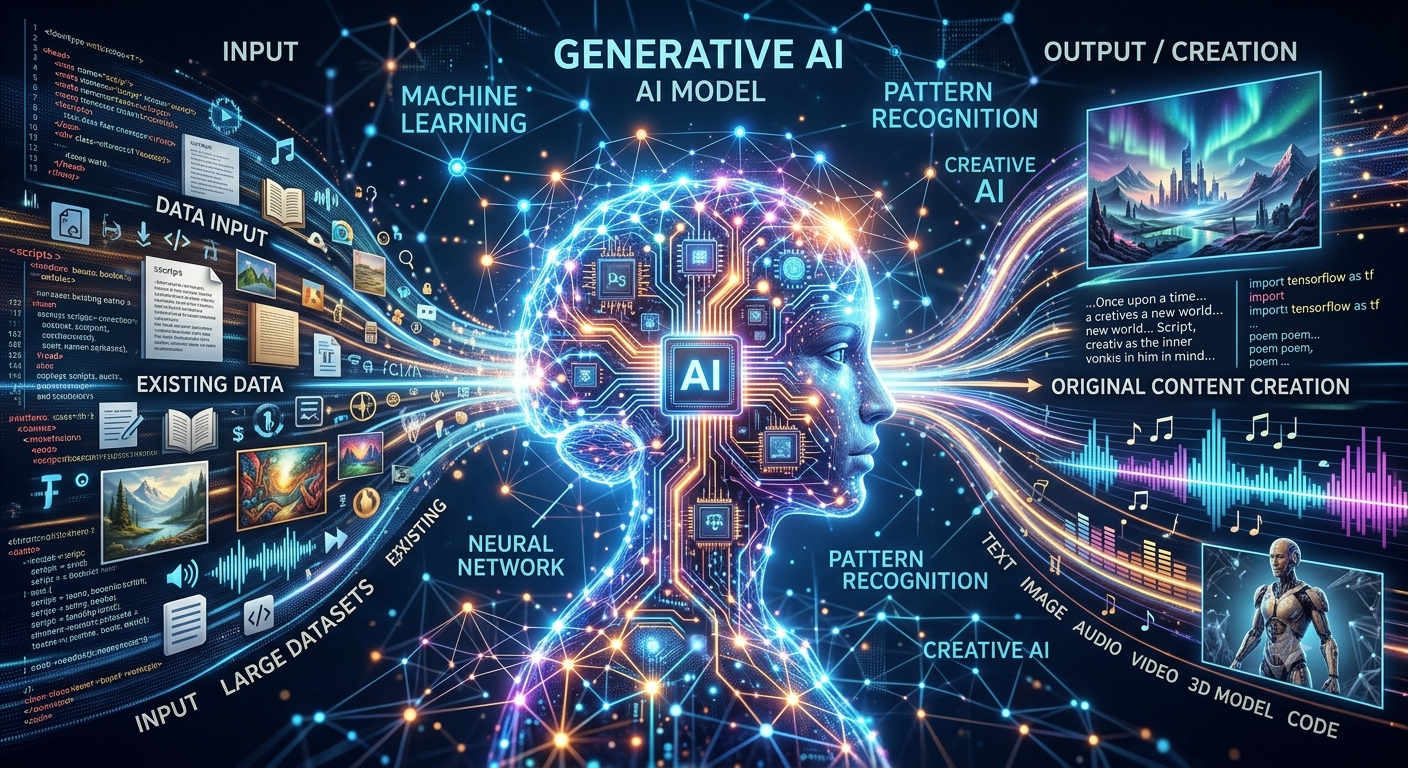
Generative AI refers to computer systems that can create new content — text, images, audio, or code — instead of simply analyzing existing data. Tools like ChatGPT, Midjourney, and GitHub Copilot fall into this category, and over the past few years they've moved from research labs into everyday workplaces. If you've been hearing the term everywhere but aren't quite sure what it means in practice, this guide breaks it down without the jargon.
How It Actually Works
Generative AI models are trained on massive datasets — billions of sentences, images, or lines of code — and learn statistical patterns in that data. When you give the model a prompt, it predicts what should come next based on those patterns, piece by piece, until it produces a full response. It isn't retrieving a stored answer; it's generating one based on probability.
Where People Are Using It
Writers use it to draft outlines and beat writer's block. Developers use it to write boilerplate code faster. Marketers use it for first-draft ad copy and product descriptions. Customer support teams use it to handle routine questions automatically. In each case, the pattern is similar: AI handles the repetitive first pass, and a human refines the result.
What It Still Gets Wrong
Generative AI can produce confident-sounding but incorrect information, a problem often called hallucination. It also reflects biases present in its training data and can struggle with tasks requiring real-time facts or precise math unless connected to external tools. Treat its output as a draft, not a final answer, especially for anything factual or high-stakes.
Conclusion
Generative AI is a genuinely useful tool for speeding up first drafts and routine work, but it works best paired with human judgment rather than left to run unsupervised. Understanding how it generates content — rather than treating it as magic — makes it much easier to use well.